

Why the first run is not the verdict
The water valves have never opened against house pressure, the insulation around a heating element has never been hot, the gas pipe behind a new cooking appliance is full of air, and the cabinet of a cold storage unit is at room temperature all the way through. The first hours of use are the machine meeting the house for the first time, and a lot of what looks wrong on that day is simply that meeting.
The useful habit on day one is to watch direction rather than state. A refrigerator that reads 50°F at noon and 44°F by evening is doing its job. A burner that clicks three times before lighting on Monday and lights at once on Tuesday has finished purging its line. What deserves a call is a symptom that holds steady or grows, and a small set of symptoms that need action the moment they appear.
Three questions that sort a quirk from a problem
Before deciding anything about the first run of a new appliance, answer these about the thing you noticed. Two yes answers to the first pair and a no to the third usually mean patience; anything else means a closer look.
- Is it improving from one cycle or one hour to the next?
- Does it trace to something new: new hoses, new insulation, an empty line, a warm cabinet?
- Is there heat, gas, smoke or water somewhere it should never be?
Cold storage: a slow first day
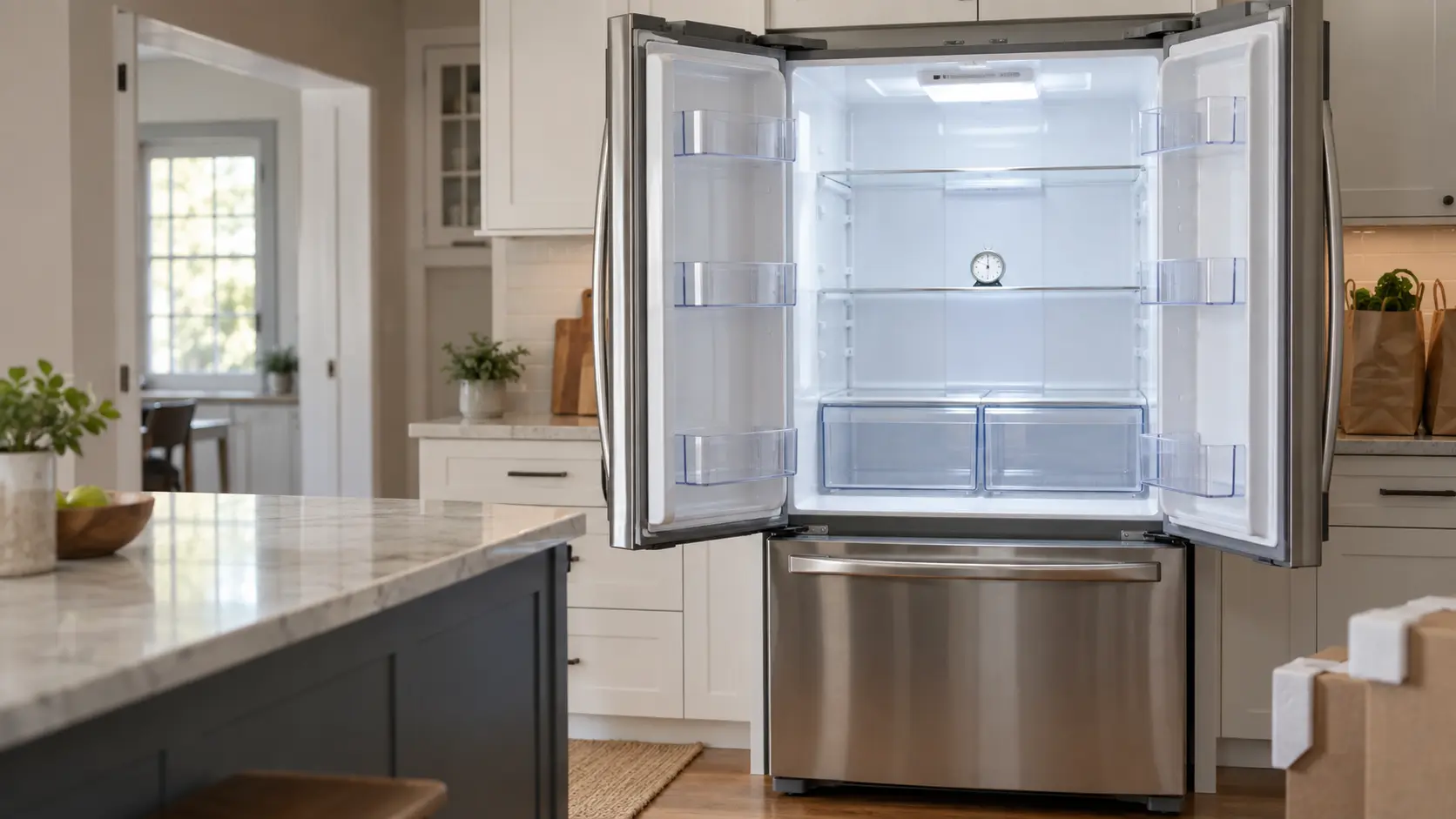
A newly delivered refrigerator or freezer starts with shelves, walls and foam all at kitchen temperature, and the compressor has to pull that heat out before the air inside holds steady. GE's troubleshooting table for its side-by-side models answers a motor that runs for long periods, and an ice maker idle in a freezer still too warm, with one instruction: wait 24 hours for the unit to cool completely. Long, continuous running during that first day is expected, not a sign of strain.
Resist the urge to turn both controls to their coldest setting. It does not speed the pull-down much, and it leaves the unit too cold once it catches up. Leave the dial at the maker's suggested setting, stand a thermometer among the middle shelves, and hold the groceries back until it shows 40°F or colder, FDA's line for a refrigerator, with 0°F as the freezer's target.
Ice from a line that has never run
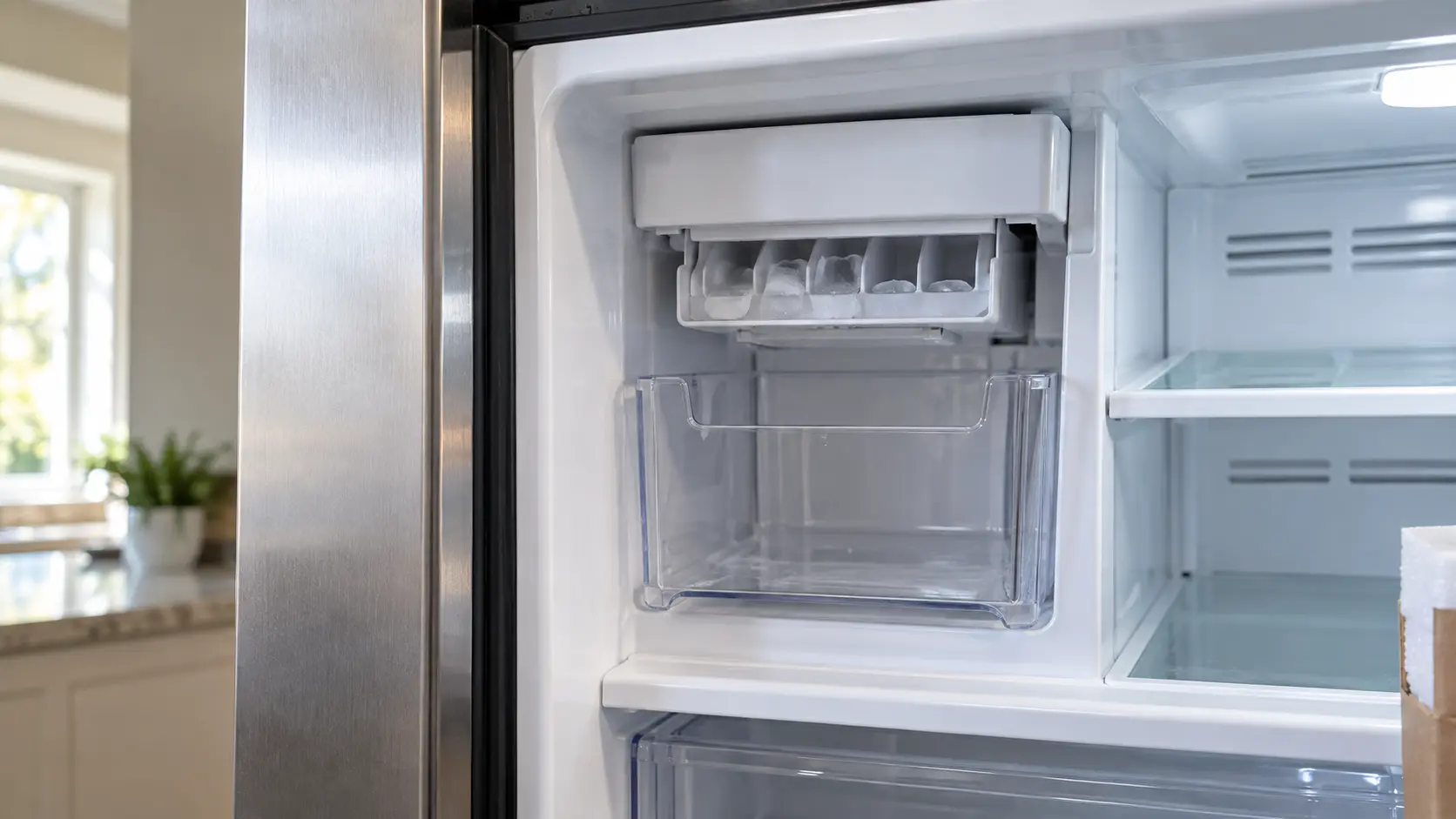
Ice comes later still. GE puts the wait for a freshly installed unit's first harvest at half a day to a full day, and asks owners to discard the early batches while the new line flushes itself through. Where house pressure runs low, GE adds, the valve can open as many as three times per batch; the repeated buzz and click from the back of the cabinet is that valve, not a leak.
Source: GE Appliances — Side by side owner's manual and installation instructions (49-60198) — Wait 24 hours for the unit to cool completely; a newly installed unit may take 12 to 24 hours to begin making ice; discard the first few batches; the water valve may open up to 3 times in low pressure; FDA — Are you storing food safely? — Keep the refrigerator at or below 40°F and the freezer at 0°F; use appliance thermometers
Cooking appliances: first heat and first light
GE's owner's manual for its electric freestanding models notes that a slight odor is normal the first time a new glass cooktop is used, because new parts and insulating materials are heating up, and that it fades within a short time. Peel every scrap of blue protective film beforehand: the same manual warns that adhesive left on the steel cannot be removed once it has baked on.
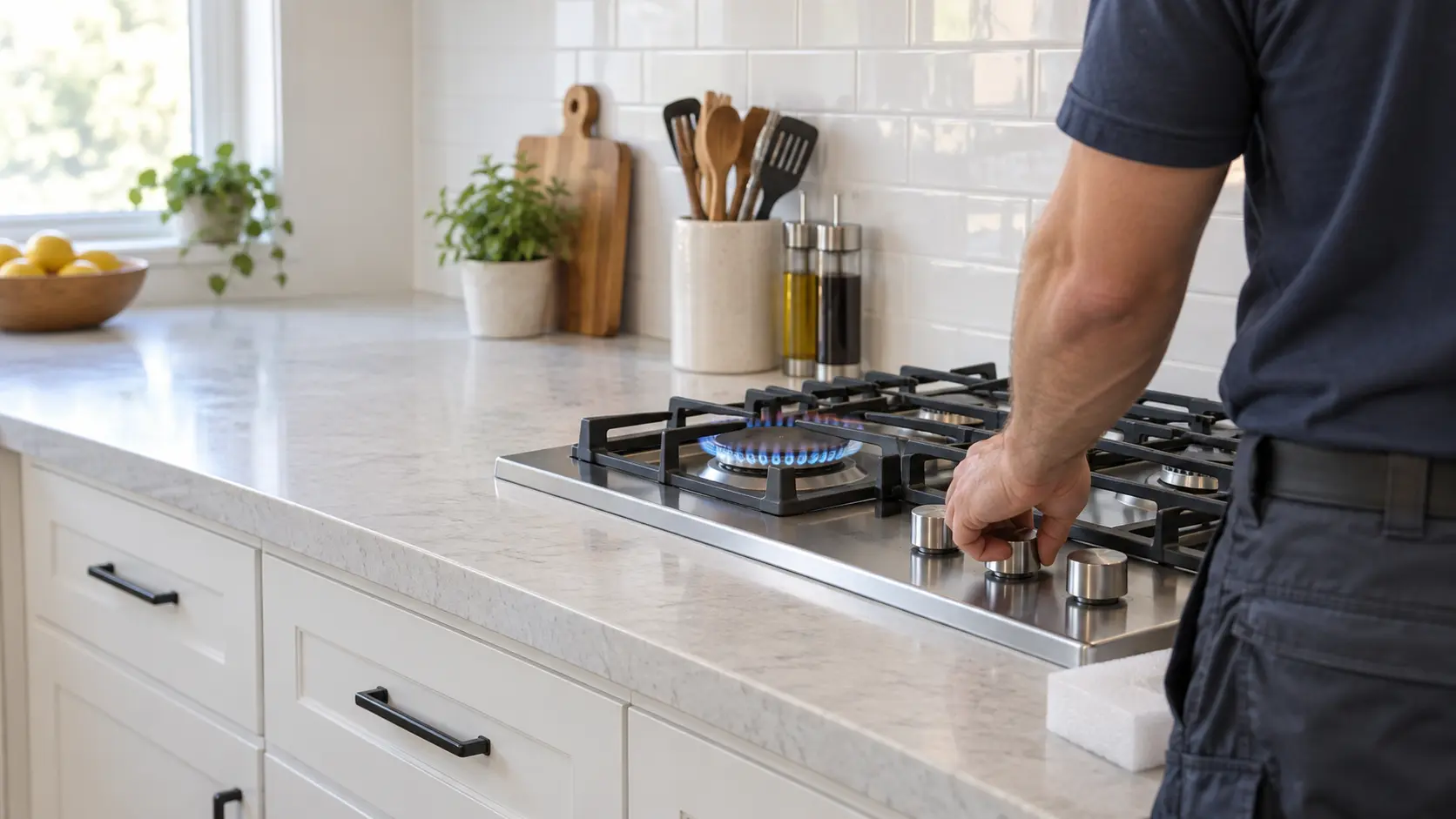
Gas models add one more first-run behavior. A newly connected supply pipe holds air, and the igniter will spark until gas reaches the burner. GE's gas installation instructions say that once the air has been purged from the supply lines, the burners should light within 4 seconds. Light each surface burner in turn, then the oven, and watch for a steady blue flame.
Clicking with no flame after a gas hookup
A few seconds of sparking on the first try is normal. Sparking that goes on across several attempts, a flame that lifts off the ports or burns tall and yellow on natural gas, or any smell of gas is not break-in. Turn the knob off, do not keep trying, and have the connection and the appliance's gas setting checked, since a unit converted for one fuel and fed the other can misbehave in just these ways.
The new oven that bakes differently
Whirlpool warns that the replacement may finish dishes sooner or later than the oven that came out, and calls some change in browning ordinary. GE's advice is to follow recipe times and temperatures carefully for the first few uses and, if the oven still seems off, to use the owner-adjustable temperature offset in the settings rather than assume a failure. Whirlpool adds that a thermometer set on the rack is a poor judge, because the elements cycle above and below the set point.
Source: GE Appliances — Electric free-standing ranges owner's manual (49-2000951) — A slight odor is normal the first time a new cooktop is used; remove all protective film before first use because baked-on adhesive cannot be removed; a new oven may cook differently, follow recipes for the first few uses and adjust the temperature if needed; GE Appliances — Gas range installation instructions (31-2001181) — Once air has been purged from the supply lines, burners should light within 4 seconds; the unit leaves the factory set for natural gas
Dish care and laundry: first fill, first spin
Water appliances show their first-run quirks by ear and by nose. GE explains that a new laundry machine can give off a strong rubber smell from its new inlet hoses, one easily mistaken for something burning. Its test is simple: start a hot fill and stop the cycle before the drum turns. If the smell is there during the fill alone, with no motor or pump running, it is the hoses, and it fades with use.
A dish care machine draws from the hot line, and GE's installation instructions ask for water between 120°F and 140°F at a pressure of 20 to 120 psi. On the first run, the pipe under the sink is often full of cold water, so the machine heats longer and the cycle runs past the time on the display. Running the kitchen tap until it is hot before pressing start shortens that first cycle.
- Rubber smell only during the fill: new hoses, fades over the first weeks
- Longer first cycle on a dish care machine: cold water in the line
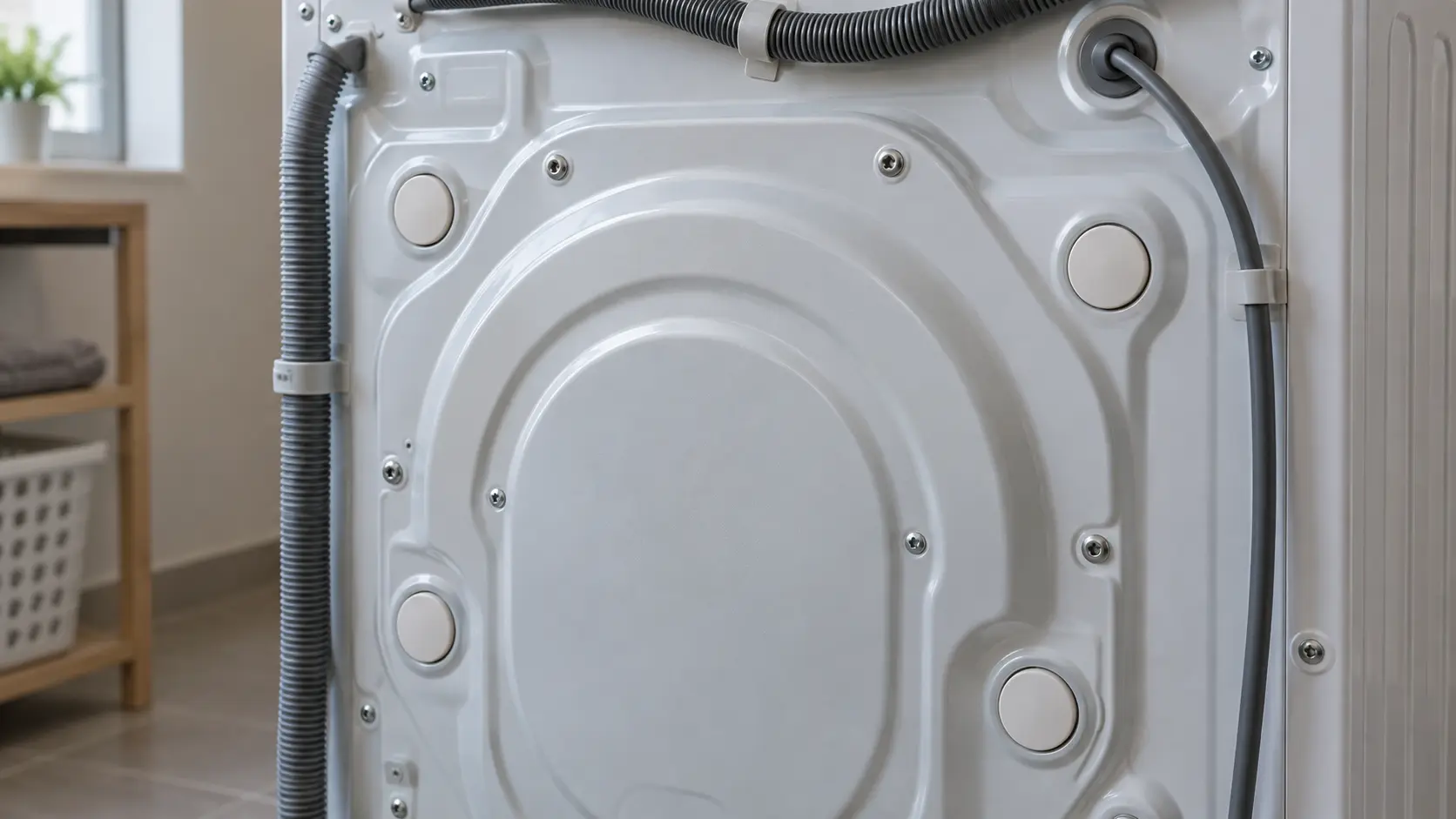
- Heavy knocking or the machine moving on its first spin: stop it and check that the transit bolts came out
- A puddle at the front after the first load: stop and look at the connections, never wait it out
Source: GE Appliances — Burning or rubber odor in a new washer — New inlet hoses can give off a strong rubber odor during fill; if it occurs before agitation it is the hoses and fades over time; GE Appliances — Built-in dishwasher installation instructions — Adjust the water heater for 120°F to 140°F; hot water supply pressure must be 20 to 120 PSI
First-run signs that are never break-in
Some symptoms have nothing to do with a machine settling in, and they are the reason to stay home for the first cycle of every newly fitted appliance. Each of them points to how the unit was connected, not to how new it is, and none improves with another cycle.
One more sign belongs in its own category: a display that lights up, answers every button and still produces no cold or no heat. That is usually a showroom setting or a supply problem rather than a failed part, and our guide to setup codes and demo mode walks through it.
- Smell of gas at any point: knobs off, appliance valve closed, no switches, leave and call the utility from outside
- Hot plastic or electrical smell, or smoke from the back or the base: switch the breaker off
- A breaker that drops the moment the unit starts: leave the switch down, since each reset only repeats the test
- Water spreading from under a machine: close the supply valve and keep away from outlets
- Warm, damp air filling the laundry room: stop the cycle, the exhaust is loose or crushed