

Laundry Exhaust Run Installation
A metal exhaust path from a new dryer to the outdoors: short transition, taped joints, a working hood.
Mon–Sat, 8am–8pm
- Moderate cost band
- 5 steps on the visit
- 4 problems it answers
Book a visit
Three short steps, about a minute.
or call (844) 638-8309
Loading appointment form…
The appointment form couldn’t load. Please try again.
What the laundry exhaust run installation
involves.
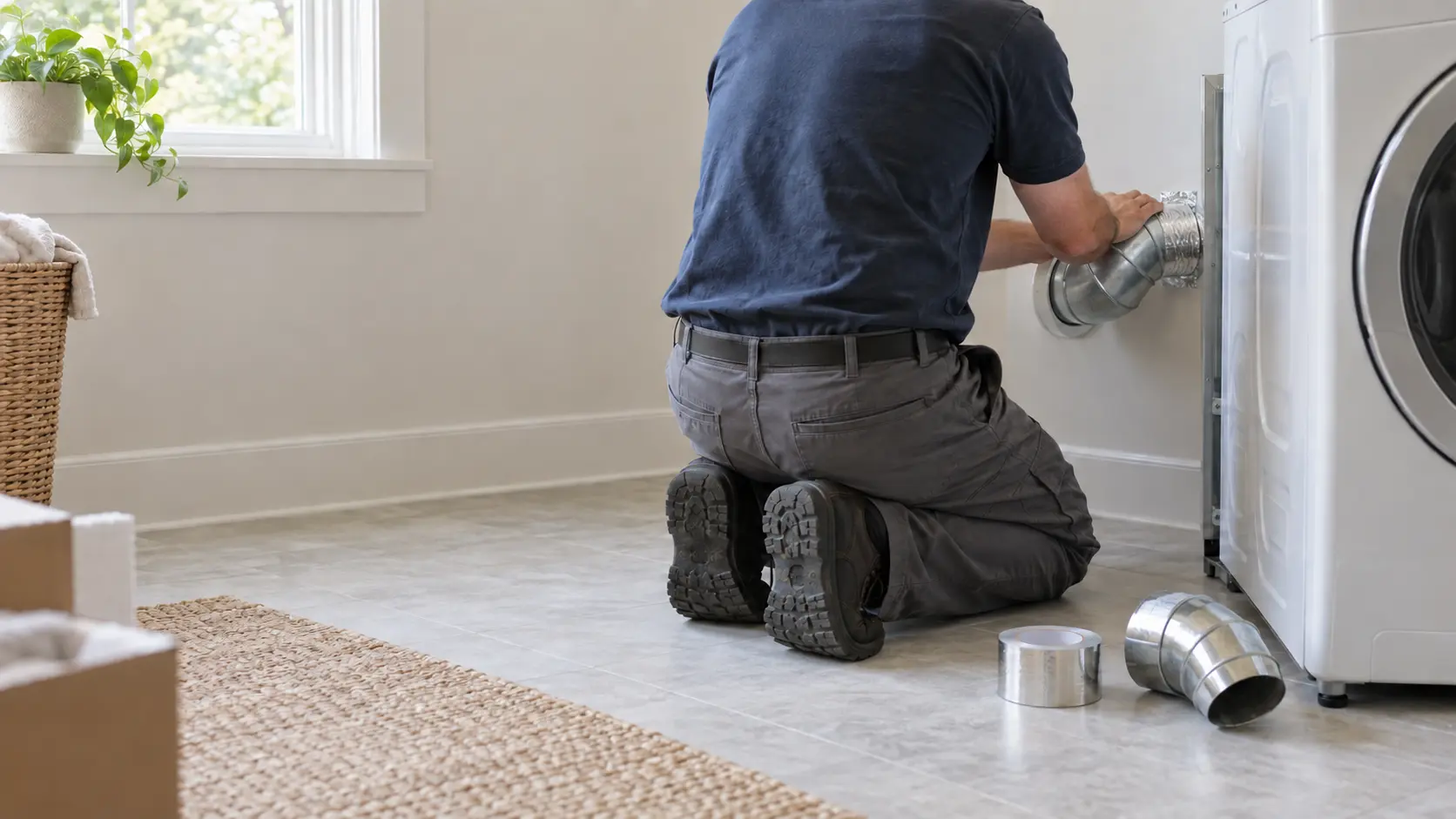
A laundry exhaust run installation gives a new vented dryer the path its maker designed for: from the outlet on the back of the cabinet to a hood outside the house, in metal, as short and straight as the room allows. It begins at the wall, where the existing run is inspected before anything is connected to it. An old run full of lint, a crushed section inside the wall or a plastic duct from an earlier installation is reported, and a run that cannot be cleaned or reused is replaced where it is reachable. The transition behind the machine is rigid or semi-rigid metal, never foil or vinyl, sized to four inches in most homes, and kept short enough that the machine sits close to the wall without folding it. Joints are connected in the direction of airflow and sealed with foil tape rather than screws, which would catch lint. The total length is checked against the maximum in the installation instructions, with each elbow counted as extra length. Outside, the hood gets a flap that opens freely and no screen that traps lint. A roof exit, a long run or a closet with little room behind the pair may call for a booster fan or a periscope transition.
How the visit goesWhat it usually costsModerate · Metal exhaust transition and reachable wall run fitted from a new dryer to the outside hood, joints taped, airflow confirmed
A short run straight through the wall behind the machine is the lighter end. A long run with several elbows, a roof or soffit exit, a closet that needs a periscope transition or a booster fan is the fuller job.
Answers 4 problemsLaundry Exhaust Crushed, Loose or Blowing Into the Room
Burning Smell on the First Run: When It Is Normal and When to Stop · Appliance Installation Code on a New Unit: Setup Modes and Hookup Messages · New Unit Vibrating or Walking Across the Floor
Comes up most onLaundry
Codes that lead hereEF1 · Check Vent / Vent Blocked · d90 · C90
Electrolux EF1: a ventilation blockage the maker calls an installation issue.
Laundry exhaust run installation,
step by step.
Run the dryer on heat and confirm strong airflow at the hood and a cabinet that does not overheat.
Measure the path from the dryer outlet to the outside hood and count every elbow along it.
Inspect and clean the existing wall run, or replace the reachable sections that are crushed, plastic or too long.
Fit a short rigid or semi-rigid metal transition, sealed with foil tape in the direction of airflow.
Check the outside hood: a free-swinging flap, no lint screen, and clear of plants, snow lines and decks.
Run the dryer on heat and confirm strong airflow at the hood and a cabinet that does not overheat.
The problems
it answers.
4 of them, from laundry exhaust crushed, loose or blowing into the room to new unit vibrating or walking across the floor.
All problems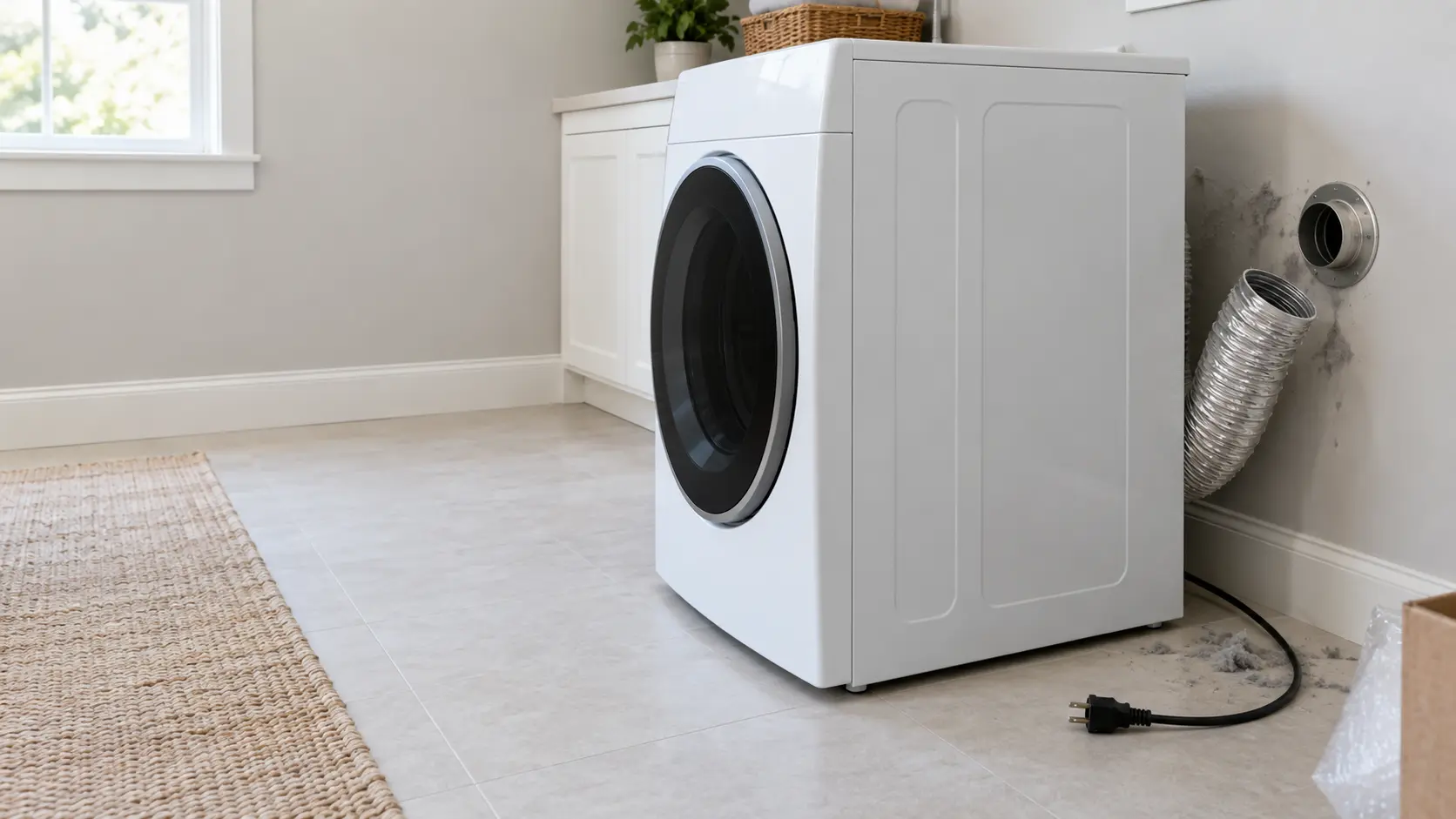
Laundry Exhaust Crushed, Loose or Blowing Into the Room
6 causes, cheapest first
Before you call
Tell us this when you book
- Whether the dryer is new and going where the old one stood, or into a new spot
- The spot outdoors where warm air comes out today, and roughly how many feet of duct lie between it and the machine
- What connects the old machine to the wall now, foil, plastic or metal
- Whether the pair will be stacked or in a closet with little room behind them
It also answers
Moderate,
on the site's scale.
A short run straight through the wall behind the machine is the lighter end. A long run with several elbows, a roof or soffit exit, a closet that needs a periscope transition or a booster fan is the fuller job.
Read the full cost guideWhere it
comes up most.
Most bookings: Laundry.
All appliance typesCodes that lead here
EF1Electrolux · Vents and ductingCheck Vent / Vent BlockedGE Profile · Vents and ductingd90LG · Vents and ductingC90Samsung · Vents and ducting
Often the same visit
The makes
we see it on.
37 makes on this site, and the laundry exhaust run installation on any of them. Each mark opens that make's own page.
All 37 brandsLaundry exhaust run installation,
where we come out.
The home, the climate and the building all change how the laundry exhaust run installation goes. These notes are about that, metro by metro.
All service areasTampa BayFL · 31 areas
Tampa Bay laundries on an outside wall make for short vent paths, and a laundry exhaust run installation there sets rigid metal duct straight out through the wall cap, with a hood that swings freely and keeps storm rain from blowing back in.
OrlandoFL · 30 areas
In Orlando vacation homes the laundry often sits in a closet off a hall or the garage, and a laundry exhaust run installation there joins the new machine to the wall with a short rigid elbow set, so the pair can stand close to the wall without crushing the duct behind it.
Miami / South FloridaFL · 47 areas
South Florida's block-walled houses are hard to cut a new vent through, and many condos cannot vent at all, so a laundry exhaust run installation there either reuses a wall cap that is already in place or points the owner toward a condensing or heat-pump model.
New York MetroNY · 75 areas
Where a New York building allows only a ventless machine, laundry exhaust run installation turns into the opposite job: the condensing or heat-pump model's water is piped to the washer's drain as the maker shows, and no duct is cut through the wall.
HoustonTX · 36 areas
Houston laundries tucked in the middle of a house can have vent runs that climb through the attic, and a laundry exhaust run installation there measures the total length and every elbow against the maker's limit before the machine is connected.
ChicagoIL · 50 areas
In a Chicagoland basement a new machine often sits well below the old vent hole in the rim joist, and laundry exhaust run installation there climbs to it in rigid metal with as few elbows as possible, keeping the outside hood above the snow line.
Los AngelesCA · 95 areas
Los Angeles houses that trade a gas laundry for an electric heat-pump pair need no exhaust run at all, while a new vented electric machine still does, and laundry exhaust run installation there sets rigid duct to the existing cap and leaves the old gas line closed for a plumber to cap.
San DiegoCA · 31 areas
In a San Diego garage conversion a laundry exhaust run installation often needs a new wall opening, and the cap and duct are placed so the vent does not blow into a neighbor's side yard or an open window a few feet away.
San Francisco Bay AreaCA · 74 areas
Bay Area flats that tuck the laundry into a garage under the house sometimes let an old machine blow straight into the garage, and laundry exhaust run installation there sets rigid duct through the wall to a real outside cap before the new machine runs.

Questions about
the laundry exhaust run installation.
Why is foil or plastic exhaust duct not used on a new installation?
Can a laundry exhaust run end in the attic or the crawl space?
What does a periscope transition do?
Back to your everyday
Ready to book the laundry exhaust run installation?
Have these to hand: whether the dryer is new and going where the old one stood, or into a new spot, the spot outdoors where warm air comes out today, and roughly how many feet of duct lie between it and the machine, what connects the old machine to the wall now, foil, plastic or metal, whether the pair will be stacked or in a closet with little room behind them.