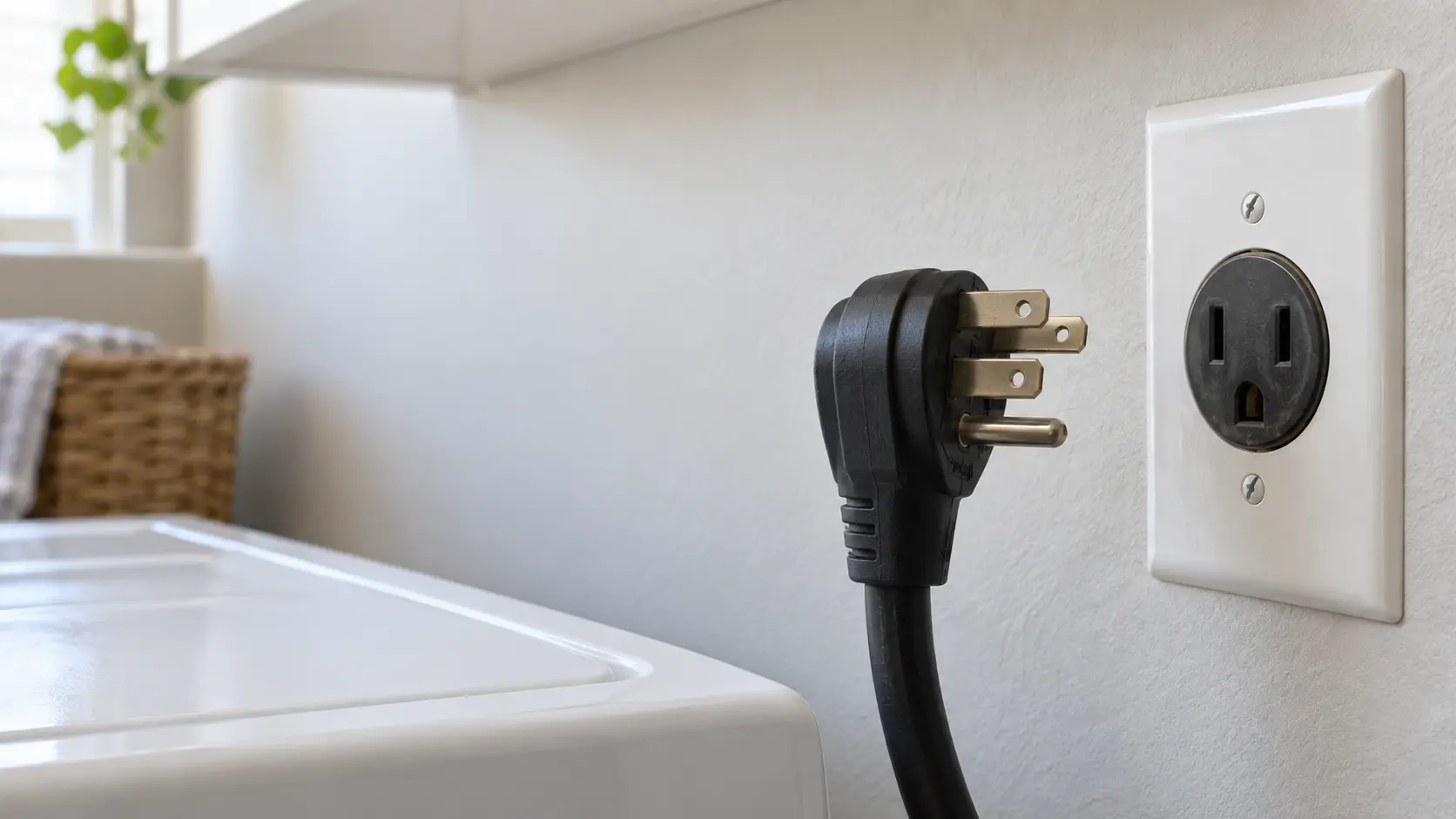

What each fuel asks of the wall behind it
Gas or electric cooking is usually argued at the stove top: flame against glass, speed against feel. For installation the more useful question is what each one needs behind the cabinet. ENERGY STAR points out that most electric cooking units need a 240-volt outlet, and that electric can be simpler to install because no gas hookup is involved. Wall ovens go further: GE's electric built-in ovens must be hard-wired into an approved junction box, and the dedicated circuit is sized from the oven's kilowatt rating, from 20 amps for the smallest to 50 amps for units rated 9.7 to 12 kilowatts at 240 volts.
Gas asks for two supplies, not one. Whirlpool's installation instructions call for a 3/4-inch rigid gas pipe to the appliance location with a manual shutoff valve that stays accessible. GE's gas instructions add a grounded three-prong 120-volt receptacle for the igniters and controls, with the owner responsible for replacing any two-prong outlet.
- Electric freestanding or slide-in unit: 240-volt receptacle on a dedicated circuit
- Electric wall oven: hard-wired junction box, circuit sized to the rating plate
- Gas unit: gas supply with an accessible shutoff, plus a grounded 120-volt outlet
- Dual fuel: both a gas supply and a 240-volt circuit
Source: ENERGY STAR — 5 reasons to switch from gas to certified electric cooking — About 33% of gas heat reaches food against 74–85% for certified electric; gas releases carbon monoxide and nitrogen dioxide; most electric units need a 240-volt outlet and can be simpler to install; induction up to three times as efficient as gas and 5–10% over conventional electric; magnet test for cookware; state IRA rebates; GE Appliances — Installation instructions, 27- and 30-inch electric built-in ovens (31-2000964) — Electric wall ovens must be hard-wired into an approved junction box; dedicated circuit sized by kW rating up to 50 A for 9.7–12.0 kW at 240 V; Whirlpool — Installation instructions, 30-inch freestanding gas units (W10658550B), archived copy — Provide a 3/4-inch rigid gas supply line with a manual shutoff valve; do not block access to it; GE Appliances — Gas range installation instructions (31-2001181) — Grounded three-prong 120 V receptacle required; leaves the factory set for natural gas; propane conversion by a qualified propane installer with orifices on the back, keep the originals; high-altitude kit above 6,000 feet; propane minimum inlet pressure 11 inches water column against 6 for natural gas; leak test with a liquid detector
Changing from gas to electric
This is the direction ENERGY STAR encourages. It notes that only about 33 percent of the heat from a gas burner reaches the food, against 74 to 85 percent for certified electric products, and that induction can be upward of three times as efficient as gas and about 5 to 10 percent more efficient than other electric cooking. It also lists the indoor pollutants gas combustion releases, among them carbon monoxide and nitrogen dioxide, and mentions state rebates under the Inflation Reduction Act, which vary by state.
For the installation, the change means a new 240-volt circuit where there may have been only a 120-volt outlet. That circuit, and any panel work it triggers, is a licensed electrician's job before the cabinets go in. The old gas stub is disconnected and capped by a plumber or gas fitter, not left live behind the new unit.
Induction and the pans already in the cupboard
Induction heats the pan itself through a magnetic field, so the cookware has to cooperate. ENERGY STAR's test is a magnet: if it sticks to the base, the pan will most likely work. Flat-bottomed cast iron, stainless steel and enameled cast iron usually pass. It is worth doing the magnet round of the cupboard before the old unit leaves.
Source: ENERGY STAR — 5 reasons to switch from gas to certified electric cooking — About 33% of gas heat reaches food against 74–85% for certified electric; gas releases carbon monoxide and nitrogen dioxide; most electric units need a 240-volt outlet and can be simpler to install; induction up to three times as efficient as gas and 5–10% over conventional electric; magnet test for cookware; state IRA rebates

Changing from electric to gas
Adding gas means a new branch of pipe run by a licensed plumber or gas fitter to the spot on the installation drawing, ending in a shutoff that stays reachable once the unit is in place. The 240-volt receptacle that fed the old unit is no longer the right outlet; a grounded 120-volt receptacle takes its place, and the unused circuit is made safe by an electrician.
On installation day the unit is connected with a new flexible connector, every joint is leak-tested with a liquid detector, and each burner is lit to check the flame. GE's gas units leave the factory set for natural gas. A propane household needs the unit converted, and GE reserves that for a qualified propane installer working from the orifice set and instructions attached to the unit's back panel; the original natural gas orifices go into a bag for any future change back.
- New gas branch to the drawing, by a licensed plumber or gas fitter
- Accessible manual shutoff at the end of it
- Grounded 120-volt receptacle in place of the old 240-volt one
- The unused circuit made safe by an electrician
- New flexible connector, liquid leak test and a flame check on installation day
Altitude and propane homes
GE requires a high-altitude kit for its gas units installed above 6,000 feet, whichever gas the unit is set for. A propane house also has its own regulator and tank supply, and GE's minimum inlet pressure for propane is higher than for natural gas. Both are details to settle with the supplier before the order, not on the day the unit arrives.
Source: GE Appliances — Gas range installation instructions (31-2001181) — Grounded three-prong 120 V receptacle required; leaves the factory set for natural gas; propane conversion by a qualified propane installer with orifices on the back, keep the originals; high-altitude kit above 6,000 feet; propane minimum inlet pressure 11 inches water column against 6 for natural gas; leak test with a liquid detector
Dual fuel and split setups
A dual fuel unit pairs a gas top with an electric oven, and it needs everything on both lists. GE notes that its dual fuel units operate on a 240-volt supply, so the kitchen needs the gas stub and the heavy circuit at the same location. The alternative split, a gas cooktop in the counter and an electric wall oven in a tall cabinet, separates the two supplies into two cutouts and two installation drawings.
The split layout gives more freedom later. Replacing the oven does not disturb the gas, and switching the top to induction touches only the counter and one circuit. That flexibility is worth weighing if the household is undecided.
Source: GE Appliances — Range and wall oven stuck in demo mode — Electric and dual fuel units operate on a 240-volt supply
The order of trades when the fuel changes
Fuel changes go wrong when the appliance is chosen last. The rough-in follows the installation drawing of a specific model, so the model has to be picked before the walls close. The electrician and plumber then work to that drawing, any required inspection happens while the wall is still open, and the cabinetmaker builds around what is there.
Papers to have before the walls close
Download the installation instructions for the exact model and give copies to each trade. Mark the receptacle or junction box, the gas stub and the shutoff on the drawing, with heights from the floor. A photograph of the open wall with a tape measure in view is the best record of where everything ended up.