
How heavy are household appliances, and who should lift them?
Weight varies enormously by group, and the number on the spec sheet beats any rule of thumb. Compact laundry and dish units can sometimes be handled by two people with a dolly, while tall cold-storage units, double ovens, stacked laundry pairs and large built-ins are crew work.
| Group | What makes it hard | Usual team |
|---|---|---|
| Laundry | Dense drum, top-heavy when tall | Two people with a dolly |
| Cooking | Long, heavy and hot-edged when new | Two to three people, protect the front |
| Cold storage | Tall, doors swing, must stay upright | Two people plus a dolly, or a crew |
| Dish care | Moderate weight, fragile front panel | Two people |
| Large built-ins | Can pass several hundred pounds | A crew with moving equipment |
The rule for owners
OSHA lists lifting heavy items, bending, and pushing and pulling heavy loads among the workplace risk factors for musculoskeletal injury, and a household move involves the same motions. If a unit needs more effort than two people can manage comfortably, do not try it; hire the crew. For stairs and built-ins, see the delivery path guide.
Which tools do the work for you?
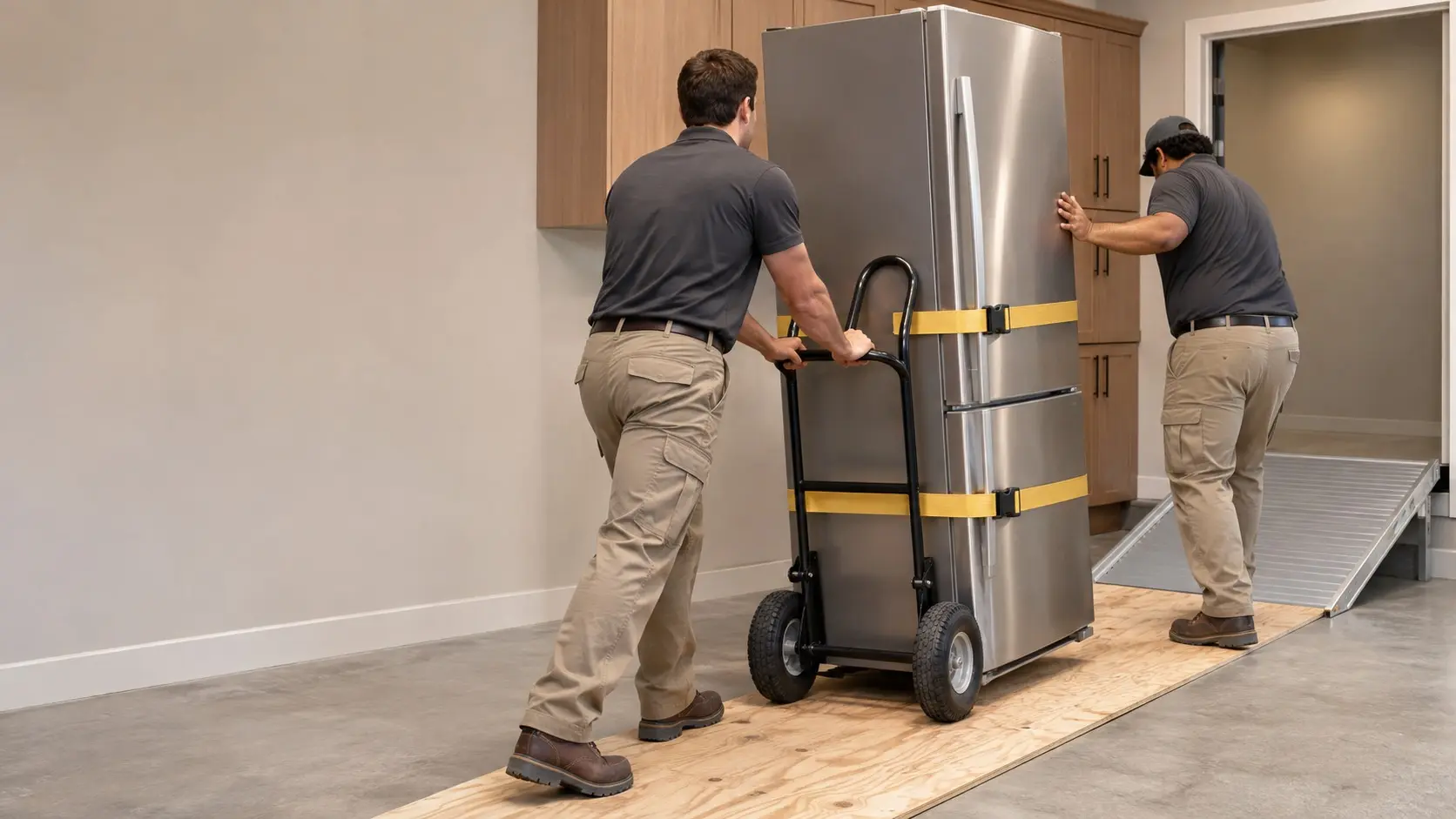
Use equipment built for appliances, not a hand truck made for boxes. A narrow flat dolly lets the unit tip, and a bare strap crushes a corner.
- Two-wheel appliance dolly with a ratchet or cam strap, and two people: one on the dolly, one steadying and watching the path.
- Moving blankets or cardboard between strap and metal.
- Four-wheel furniture dolly for short, flat distances.
- Plywood or hardboard runners to spread weight across a floor.
- Corner guards or foam pipe insulation for door frames.
- Work gloves and shoes with a grip.
How to strap a unit
Tilt the unit back only as far as the manual allows, slide the dolly under the side that bears the load, and strap it snugly around the body so it cannot slide out. Never tip it further than the manual allows, or onto a side the manual does not permit. Pull the strap until the blanket compresses and the unit no longer moves on the dolly when you push it.
Never use these as handles
Do not lift by a door, a handle, a lid, a control panel or a rack. They are attached to hinges and light frames and can tear off. Lift by the body or the base, from the sides that the carton or manual shows.

Which units must stay upright?
Anything with a sealed cooling system should travel upright, because oil from the compressor can run into the cooling lines when the unit is laid down. Where the manual allows a tilt or a lie-down, it also says how long to wait before running the unit.
- Cold-storage units: upright; if one was laid down, follow the manual's wait time before plugging it in.
- Laundry machines: tilt only for the dolly, with the drum locked as the manual describes; see removing shipping bolts.
- Cooking units: keep the glass door closed and taped, and never carry by the oven door.
- Dish units: keep upright, and do not lay them on the door.
Disconnect first
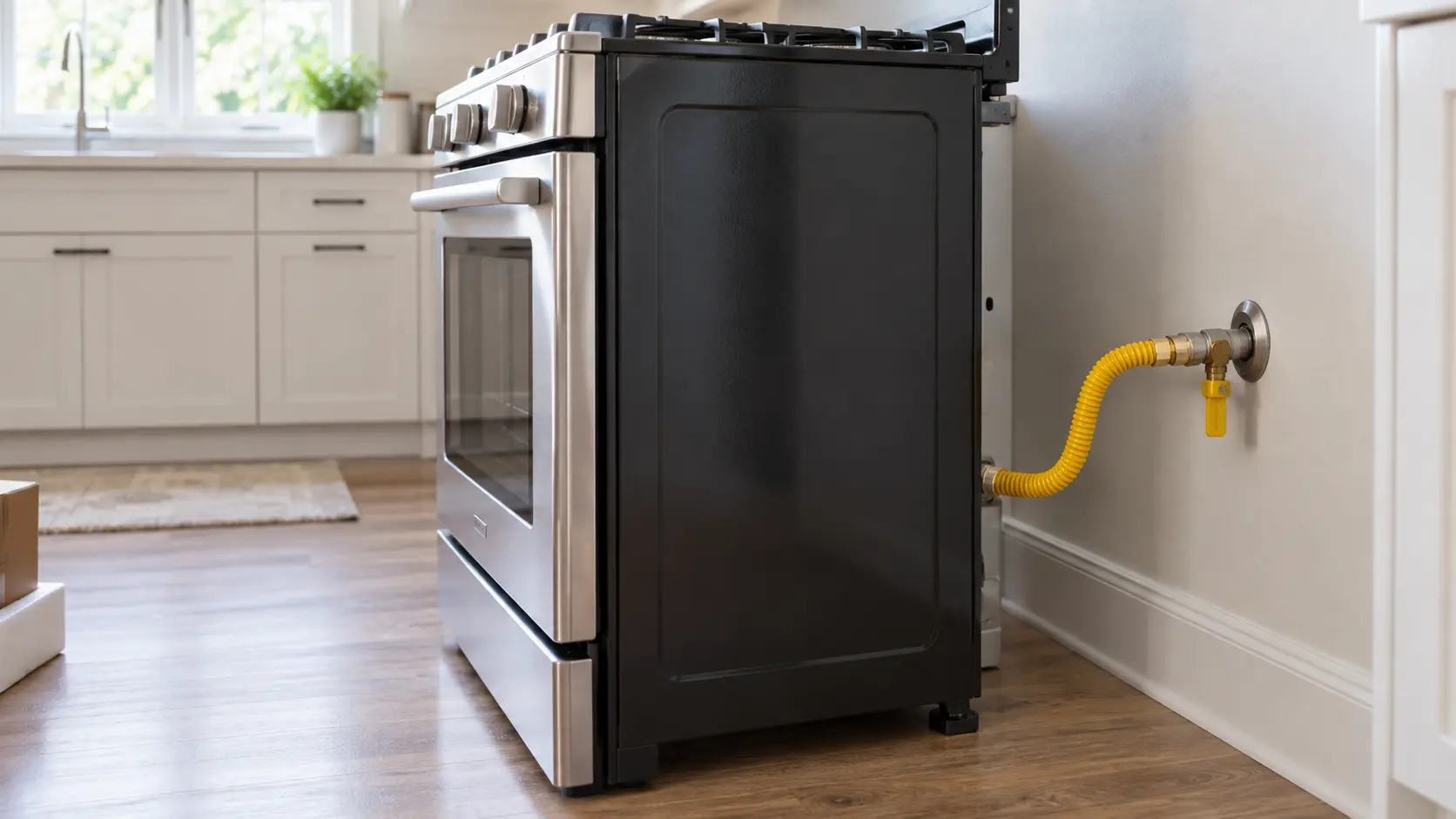
Before a unit moves, someone has to disconnect it safely. Water lines get closed and drained, cords get unplugged, and gas lines get disconnected and capped by a qualified installer or the gas utility, never by the owner. When the unit is pulled out, ease it forward slowly and stop before any gas connector, water line or cord pulls tight, kinks or rubs. An old appliance disconnect and removal visit covers this, and the delivery day checklist shows how to prepare the old unit.
How do you protect floors, doors and the unit?
Lay protection down before the move and keep it in place until the unit is in position. Gouges and dents nearly always happen at the thresholds and the turns, so protect those first.
Floors
Use runners of plywood or hardboard over hardwood, tile and vinyl, taped at the seams. Look for soft spots or a flexing floor before putting hundreds of pounds on it; a floor that gives under a footstep is not ready for a built-in. Do not slide a unit on its feet or its wheels across a finished floor.
Door frames and corners
Remove the door or trim if the clearance is tight, and pad the frame with foam or a blanket. Take the unit's own doors and handles off only when the manual allows it, and put the screws in a labeled bag. Turn the unit so the narrow side leads through a doorway.
Protect the unit
Wrap the front, the corners and the control panel. If you plan a move after installation, inspect it the way the new-appliance delivery damage guide describes, so any damage is noted before the unit leaves your hands.
What do you do when it goes wrong?
Stop moving at the first sign of trouble. Do not catch a falling unit; step clear and let it fall, because the injury risk is far greater than the repair bill.
- If it tips, step back, and do not try to hold it.
- If it jams in a doorway, back it out rather than forcing it through.
- If a strap slips, lower the unit to the floor on its dolly before you re-strap.
- If it was dropped, treat it as damaged until it has been checked.
Check the unit after any bump: open and close the doors, confirm it sits level, and look for dents and loose panels. A tilted or dropped unit that no longer sits square may need leveling and anti-tip work or a look from a pre-installation site check before it is connected.


