


Drain Backing Up After an Install: Plug, Loop and Standpipe
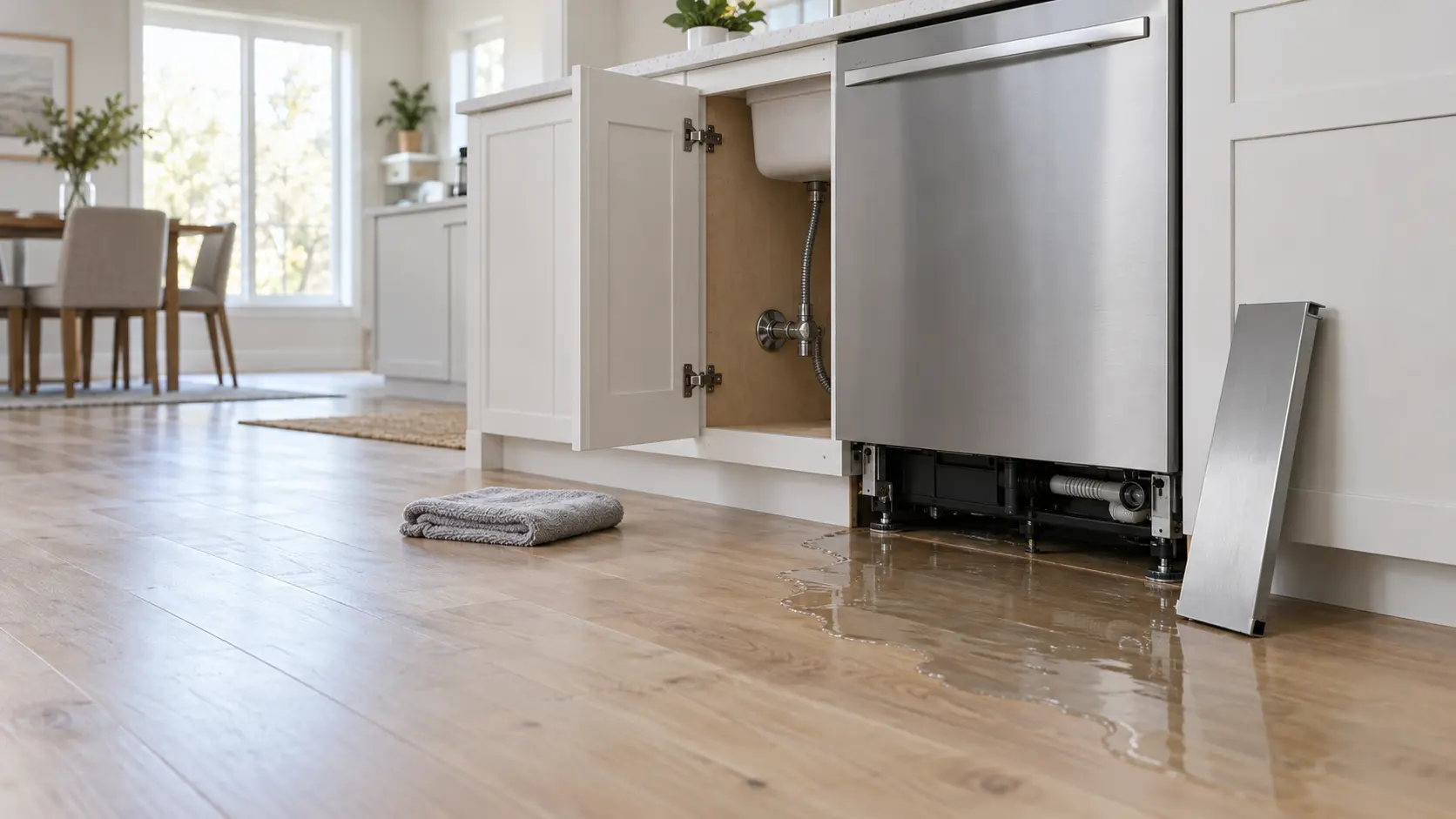
A drain backing up after an install leaves water standing in a new machine, pushes it into the sink or spills it over the top of the standpipe.
Mon–Sat, 8am–8pm
- 5 checks before you book
- 5 questions that narrow it
- 6 causes, cheapest first
Book a visit
Three short steps, about a minute.
or call (844) 638-8309
Loading appointment form…
The appointment form couldn’t load. Please try again.
What it
usually means.
A drain that worked with the old machine can refuse the new one for reasons that have nothing to do with the new machine's pump. The classic case is a new disposer: every one ships with a knockout plug sealing its dishwasher inlet, and the first cycle after the swap ends with the tub full of water. A drain hose that lost its high loop, lying flat along the cabinet floor, lets sink water run back into the tub, so the dishes come out gray. A hose kinked behind a machine that was pushed back too far drains slowly or not at all. On a washer, a drain hose pushed too deep into the standpipe or sealed around its opening siphons, and a new model's stronger pump can overwhelm a standpipe that is too short or partly blocked, sending water over the top. A built-in ice maker with a gravity drain needs a real fall to its drain, which a counter-height installation does not always give. Most of these are fixed by the connection, not by a part. A drain line inside the wall that is blocked belongs to a plumber, and a drain pump that has failed is the maker's under warranty and our sister repair site's after it.
 The 6 causes, cheapest first
Answer these first
Where does the water back up: into the machine, into the sink, or over the standpipe?
Is the disposer new, or was it replaced at the same time as the machine?
Does the drain hose rise to a high loop or an air gap before it drops to the drain?
Is the hose visibly kinked or flattened behind the machine?
Do the sink or the laundry tub drain slowly on their own, with no machine running?
Check these
before you book.
Drain backing up after an install: 5 checks, and none of them costs anything.
Stop the cycle, and let the water settle before you open the door.
Look under the sink for the drain hose: does it rise to a high loop or an air gap, or lie along the floor?
If the disposer is new, ask whether its knockout plug was removed; do not reach into a disposer yourself.
Also worth checking
- Behind a laundry machine, see how far the drain hose goes into the standpipe and whether it is sealed.
- Fill and empty the sink with the machine idle; if it drains sluggishly too, the house line is part of the story.
How soon does it need a visit?
A drain that backs up is not an emergency unless water is spilling onto the floor near outlets. In that case shut the water at its valve, stay clear of anything electrical near the puddle, and use the breaker only if the panel stands somewhere dry.
The causes,
cheapest first.
6 things drain backing up after an install: plug, loop and standpipe turns out to be, from the disposer knockout plug still in place to a gravity drain without enough fall.
The cost guide-
01 lowest
The disposer knockout plug still in place
The plug inside the disposer's dishwasher inlet is knocked out with the disposer off and its power cut, and the loose plug is fished out of the grinding chamber. The first drain then runs freely.
-
02 lowest
A hose that never climbs before it drops
A hose that runs low lets sink water siphon into the tub. It is raised and fastened to the underside of the counter, or run to an air gap where local code asks for one.
-
03 lowest
A laundry drain hose sealed into the standpipe
A hose pushed deep or taped tight into the standpipe siphons water out as the tub fills. It is set to the depth the maker gives, held with its guide, with air space around it.
-
04 low
A hose kinked behind the machine
Setting the machine too far back folds the hose where it leaves the cabinet. The machine is pulled forward, the hose rerouted and supported, and the unit set at the depth the instructions give.
-
05 low to moderate
A standpipe too short for the new pump
A stronger pump pushes water faster than a short or partly blocked standpipe takes it. The connection and height are checked; changing the standpipe or clearing the drain line inside the wall is a plumber's work.
-
06 low to moderate
A gravity drain without enough fall
A built-in ice maker that drains by gravity needs a drain lower than its outlet. Where the fall is not there, a drain pump version or a pump kit from the maker lifts the water to the sink drain.
What else
it could be.
Most often confused with water leak after an install: close the supply valve first, then water hammer after a hookup: banging pipes when a valve shuts.
All problemsCodes that come with it
F11ASKO · Water supply and drainE18Bosch · Water supply and drainError 800115Cove · Water supply and drain4CDacor · Water supply and drain5CDacor · Water supply and drainBlank display / OFF after power interruptionDCS · Water supply and drain
Also related


The makes
it happens on.
37 makes on this site; drain backing up after an install: plug, loop and standpipe can show up on any of them. Each mark opens that make's own page.
All 37 brandsDrain Backing Up After an Install: Plug, Loop and Standpipe,
where we come out.
9 metros, each with its own page.
All service areasTampa BayFL · 31 areas
Miami / South FloridaFL · 47 areas
New York MetroNY · 75 areas
HoustonTX · 36 areas
ChicagoIL · 50 areas
Los AngelesCA · 95 areas
San DiegoCA · 31 areas

Questions about
drain backing up after an install: plug, loop and standpipe.
Why is there dirty water in the new machine before it was ever used?
Can I knock out the disposer plug myself?
How high should the laundry standpipe be?
Does a new machine with a stronger pump need a different drain?
Back to your everyday
Still seeing drain backing up after an install: plug, loop and standpipe?
Book with what you checked above — 5 answers save the technician the first part of the visit.